

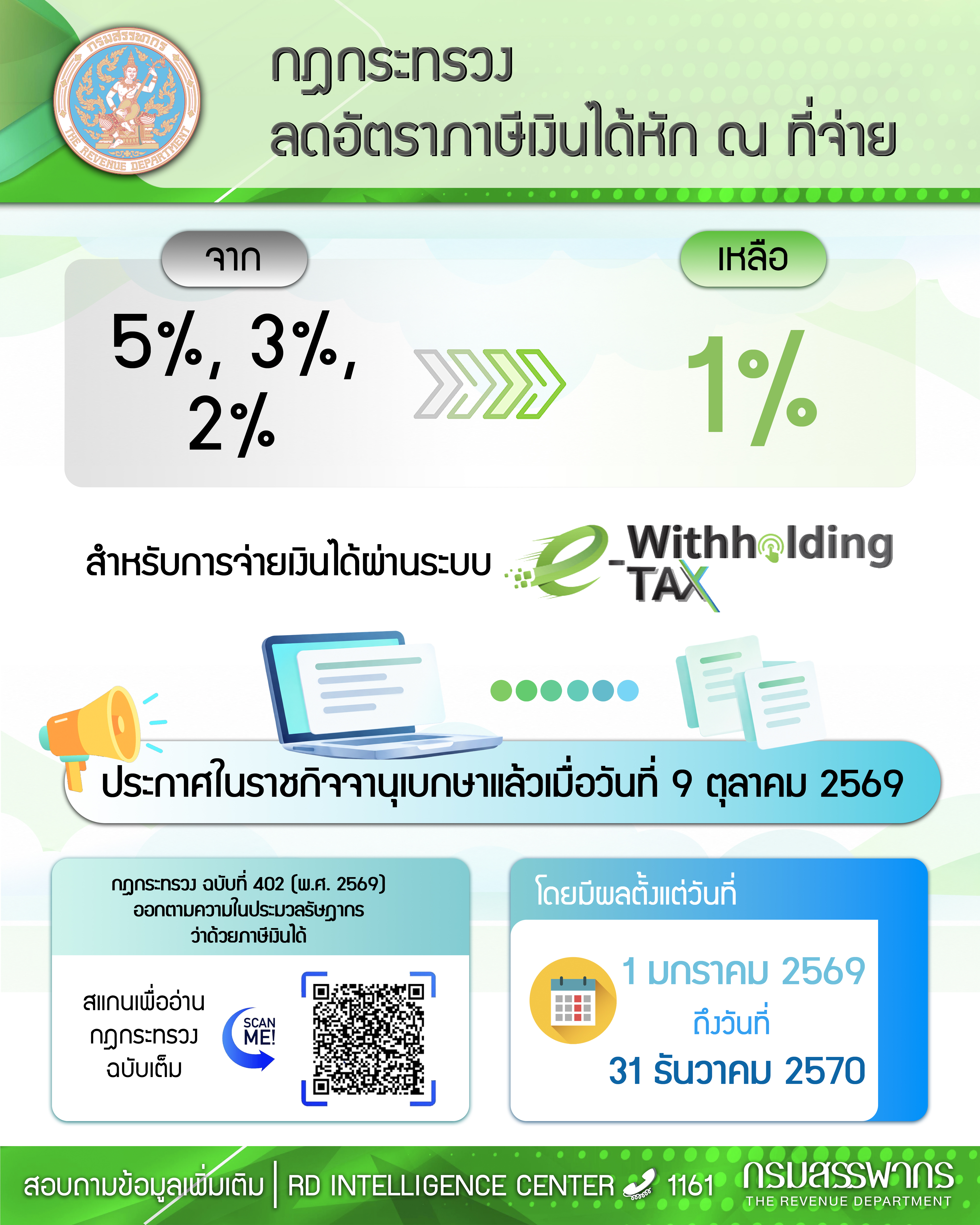
Thailand’s reduced 1% e-Withholding Tax rate is available for specified payments made from 1 January 2026 to 31 December 2027, subject to the prescribed payment and remittance conditions. The Revenue Department confirmed the published regulation in its 15 October announcement. The rate does not apply to every supplier invoice simply because the company pays online.
Before approving a payment, establish what the company is paying for, who receives it and whether the transaction will actually pass through the e-Withholding Tax service. Then approve the supplier’s net receipt and the withholding amount together. This is particularly useful when a director approves a batch of payments prepared by someone else: the approval should identify the tax treatment as well as the amount leaving the bank.
This guide focuses on supplier payments by businesses operating in Thailand. Overseas payments, mixed contracts and unusual recipient arrangements may require separate analysis.
What changed in October 2026?
Ministerial Regulation No. 402 was signed on 1 October 2026 and published in the Royal Gazette on 9 October. It provides the 1% rate for prescribed income categories paid within the 2026–2027 period when the required electronic remittance method is followed. The October publication date and the January starting date therefore serve different purposes.
For a finance team, the immediate task is to review the payment instructions used today and identify earlier transactions that may need attention. Updating a single rate in an accounting system is insufficient if the bank instruction still sends the payment through an ordinary transfer service.
Keep the treatment attached to the transaction. A purchase order, contract, invoice and payment instruction should tell a consistent story about the service, recipient and amount. If those documents disagree, resolve the difference before the payment is released.
An online transfer, e-Filing and e-Withholding Tax are different
A company can manage its entire payment cycle online without using e-Withholding Tax. The distinction is the service used to remit the tax and its information, rather than whether someone clicks a button instead of visiting a branch.
| What the team does | What it establishes | What to confirm before using 1% |
|---|---|---|
| Makes an ordinary internet banking transfer | Money was sent to the supplier. | Whether a qualifying e-Withholding service was actually selected and used. |
| Submits a withholding return through e-Filing | A return was submitted through that filing channel. | Do not treat the filing channel as proof of e-Withholding remittance. |
| Uses a participating bank’s e-Withholding Tax service | The payment follows the service arranged for sending money, withholding tax and transaction information. | Confirm the transaction qualifies and the correct details reach the bank and Revenue Department. |
Scroll this table sideways to see all columns.
The Revenue Department’s SME withholding guide, in its section on electronic remittance, explains the participating-bank process. The payer arranges the service with an approved bank; the bank sends the supplier’s money and remits tax and information to the Department.
Ask the bank which service applies to your account and how to recognise its confirmation. An online transfer receipt bearing the bank’s logo does not, by itself, explain which withholding process was used.

Check the payment and recipient before choosing a rate
The regulation covers specified categories, with conditions relating to the income and recipient. It is not a universal reduction across the Revenue Code. For example, its residual-services provision excludes hotel services, restaurant services and life-insurance premiums. The rent provision has a specific exclusion for ship charter under the maritime-promotion law for international goods transport. An exclusion from this provision does not establish that a payment is free of withholding tax; its applicable treatment still needs assessment. Payroll should not be moved to 1% because the company has adopted e-Withholding Tax for suppliers. Consult the actual categories and exclusions in Regulation 402.
A useful starting point is the underlying agreement. Is the invoice for a service, rental, goods, or a combination? Does the payee named on it match the contracting party and the proposed bank beneficiary? Is that recipient an individual or a company? An invoice description such as “monthly fee” may be too vague to answer these questions.
Where a contract combines several activities, do not select a rate from the invoice heading alone. Give the accountant the scope of work and the relevant breakdown. Likewise, a familiar supplier’s new contract may need a different assessment from the previous one.
Our PND3 and PND53 guide explains the wider withholding decision and the information to collect. This article addresses the additional channel and eligibility checks needed for the reduced electronic rate.
Who benefits from the difference between 3% and 1%?
Consider a hypothetical THB 100,000 service fee, excluding VAT. Assume the transaction would normally be subject to 3% withholding, qualifies for 1% through e-Withholding Tax, and has no gross-up agreement, bank fees or other deductions. These assumptions are essential; the example does not classify a real invoice.
| Item | Assumed ordinary 3% treatment | Qualifying 1% e-Withholding treatment |
|---|---|---|
| Fee before withholding | THB 100,000 | THB 100,000 |
| Withholding tax | THB 3,000 | THB 1,000 |
| Net amount received by the supplier | THB 97,000 | THB 99,000 |
| Supplier receipt plus tax remitted | THB 100,000 | THB 100,000 |
Scroll this table sideways to see all columns.
The supplier receives THB 2,000 more at payment. The payer’s fee remains THB 100,000 under these assumptions. The difference is not a THB 2,000 discount on the service, nor a reduction in the payer’s expense.
Withholding is an advance collection of income tax. The recipient generally uses the amount withheld as a credit when calculating the relevant year’s tax, as explained in the Revenue Department’s SME guide. Lower withholding can improve immediate cash availability while leaving more tax to settle later, depending on the final calculation.
If the contract promises the supplier a fixed net amount, ask for a fresh calculation. A net-fee or gross-up agreement changes the arithmetic; do not reuse this table unchanged.
A decision card for the next supplier payment
Imagine that an administrator prepares a payment for a Thai supplier. The invoice says “professional services”, and the director remembers seeing news about the 1% rate. The bank account already supports online transfers, but nobody has confirmed whether the specific e-Withholding service is active.
The right next step is to resolve that channel question alongside the income classification. The company should not approve 1% on the assumption that “electronic payment” and “e-Withholding Tax” mean the same thing.
Use three possible outcomes:
- Ready to approve: the accountant has confirmed the payment’s treatment, the recipient details are correct, the service is available, and the instruction shows the agreed gross amount, withholding and supplier receipt.
- Tax question outstanding: the contract, recipient status or classification is unclear. Send the documents to the accountant and obtain an answer before choosing the rate.
- Channel question outstanding: the transaction has been assessed, but the bank service or instruction is unconfirmed. Resolve this with the bank before relying on electronic-rate treatment.
These are approval controls, not a substitute for the legal assessment. If a payment is urgent, record what is unresolved and ask the accountant and bank how it should be handled. Urgency does not supply the missing evidence.
Agree who prepares, checks and releases the payment
The person who knows the supplier may not be the person who prepares the bank instruction. Make the handover explicit.
The purchaser or service owner should provide the agreement and explain what was delivered. The accountant should assess the relevant treatment and specify the information needed. The payment preparer should enter the approved details, and the authorised approver should check the exact instruction being released.
For a small business, one person may hold several roles. A short written approval still helps: it prevents the accountant’s answer to one invoice being applied automatically to every invoice in the same batch.
Tell the supplier the approved gross fee, withholding amount and expected net receipt before payment. This gives both sides an opportunity to identify a mismatch in the contract, recipient name or calculation while it can still be corrected through the normal approval process.
Recheck an instruction that changes after approval
A payment may be approved for the qualifying service and then switched to an ordinary transfer because the preparer cannot complete the original instruction. That change matters even if the recipient and invoice are unchanged. The calculation was approved on the basis of a particular route; it should not be copied into a different route without reassessment.
Agree what the preparer should do if the service is unavailable, an instruction is rejected, or the supplier asks for a different beneficiary account. Return the changed instruction to the appropriate checker and approver. Preserve the original confirmation or rejection so the accountant can distinguish an attempted transaction from a completed payment.
Where several people can release payments, make the latest approved version easy to identify. A message saying “approved” is ambiguous if the amount, withholding or channel has since changed. Reference the invoice and the version of the instruction so the person releasing funds does not rely on an earlier answer.
This is also useful when an external accountant prepares the calculation while the company retains bank approval. The accountant needs to hear about a change made at the bank stage; otherwise the books may describe the intended payment rather than the transaction that occurred.
Keep evidence that connects the bank transaction to the accounts
For each payment, retain the invoice and agreement, the approved tax calculation, the payment instruction, the bank’s confirmation and the information needed to find the corresponding tax record. Use a common transaction reference where practical. A folder containing the right documents is useful only if the team can identify which documents belong together.
The Revenue Department’s e-Withholding Tax FAQ says taxpayers can check records after six bank working days, excluding weekends and bank public holidays. It identifies incomplete processing, use of a different filing system, and failure to instruct the bank to remit through e-Withholding Tax as possible reasons for missing records.
This record-availability guidance is not a filing or payment deadline. Build a follow-up into the payment routine. Compare the recipient, payment date, income amount and tax amount with the approved instruction. If the information is absent or inconsistent, investigate the specific transaction rather than assuming that the bank payment proves every step succeeded.
Check the taxpayer, establishment and recipient details required by the bank’s service against the underlying records. Resolve any mismatch before approving the instruction; do not infer the correct establishment from a default value.
Keep ordinary and e-Withholding transactions separate in the monthly close
A business may use more than one payment channel during the same month. Some suppliers may be paid through e-Withholding Tax; other transactions may remain in the ordinary withholding workflow. The accountant needs to know which route each transaction actually followed.
The RD’s participating-bank explanation says the payer does not separately file the withholding return or issue the section 50 bis certificate for the transactions handled through that process. That transaction-level scope matters: it does not remove unrelated obligations for the company’s other payments. See the electronic-remittance diagram in the SME guide.
At month-end, review the ordinary-channel list and the e-Withholding list against the accounts and bank movements. Investigate a payment appearing on both lists, an invoice with no identifiable route, and any difference between the approved tax and the recorded amount. Keep unresolved items visible with a named person responsible for obtaining the missing evidence.
How should earlier 2026 payments be reviewed?
The qualifying payment period begins before the regulation’s October publication. That makes the company’s 2026 payment history relevant, but it does not justify changing every historical withholding entry to 1%.
Start with the original transaction: its payment date, contract, recipient, classification, actual bank service, tax amount and remittance evidence. Separate payments made through e-Withholding Tax from ordinary transfers followed by conventional filing. Then ask the accountant whether any discrepancy requires a correction and which party needs to act.
Do not reduce a future remittance to compensate for a suspected past overpayment without an established correction basis. Do not promise a supplier an automatic refund before the original records and applicable procedure have been assessed. The payer’s accounts, the bank’s submitted information and the supplier’s tax records need to remain consistent.
For the year-end file, retain the conclusion on each reviewed exception: no change required, information corrected, further action pending, or another documented outcome. Our year-end accounting checklist explains how to make unresolved issues visible before the annual accounts and audit work begin.
Before you release the next payment
Confirm these points together:
- The contract and invoice explain the payment being made.
- The recipient’s identity, tax details and relevant branch information are confirmed.
- The accountant has approved the applicable treatment and calculation.
- The intended bank service matches that treatment.
- The approver can see the gross fee, withholding and net supplier receipt.
- Someone will check the resulting evidence and resolve any mismatch.
YPN provides tax support and bookkeeping and reporting for businesses in Thailand. Bring the supplier agreement, invoice, proposed payment details and any earlier bank or filing evidence. We can discuss the review and ongoing accounting support your company needs.